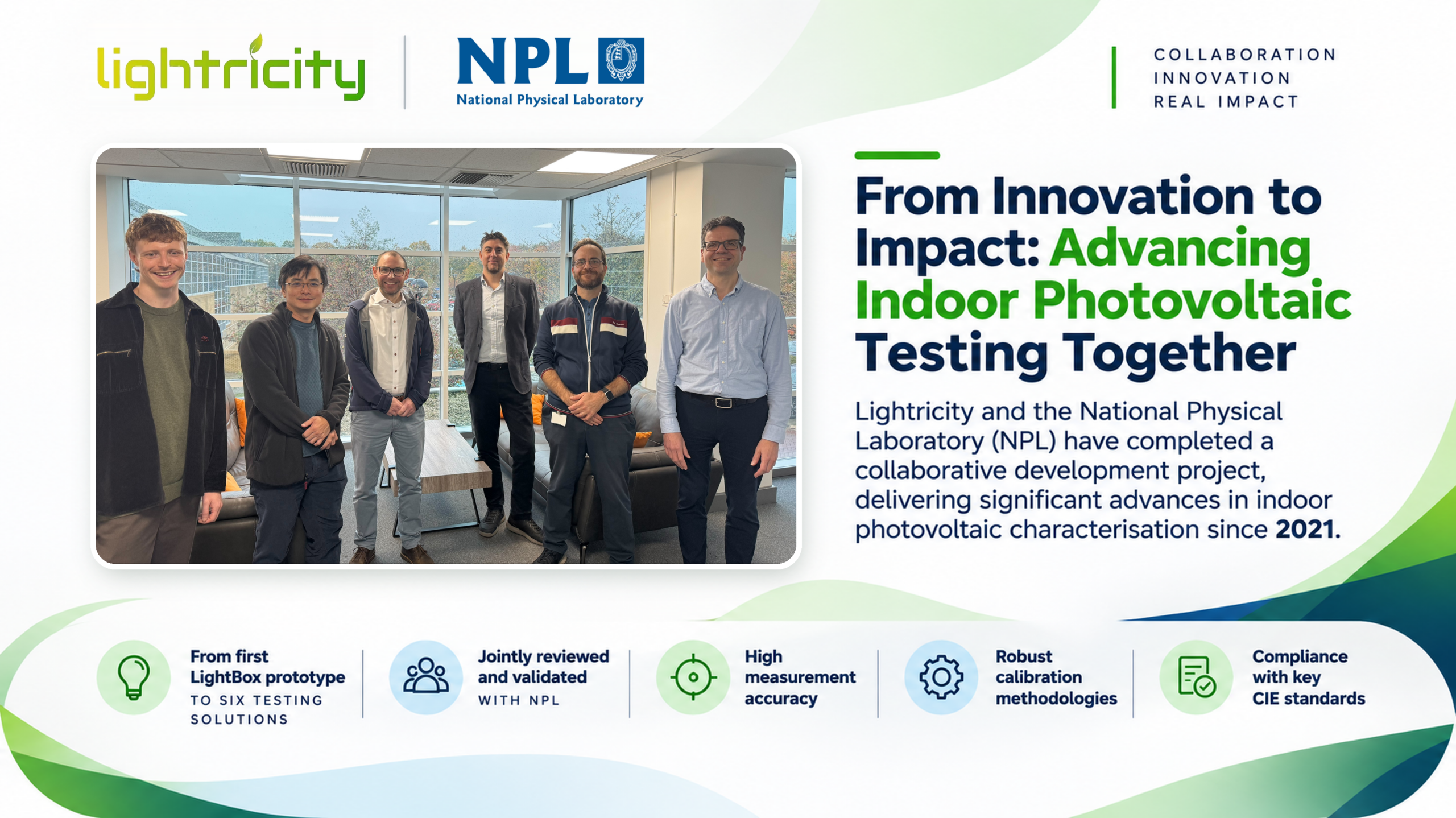
From the first LightBox prototype to a portfolio of six testing solutions, Lightricity’s collaboration with the National Physical Laboratory (NPL) has strengthened the accuracy, calibration and reliability of indoor photovoltaic characterisation.
Overview
Lightricity has successfully concluded a collaborative development project with the National Physical Laboratory (NPL), marking an important milestone in the advancement of indoor photovoltaic (PV) testing and measurement technology.
Since 2021, the partnership has combined Lightricity’s expertise in indoor light energy harvesting with NPL’s specialist measurement science capabilities. What began with the first LightBox prototype has evolved into a portfolio of six testing solutions, which have been jointly reviewed and validated.
Through the collaboration, Lightricity’s commercial testing platforms have benefited from improved measurement accuracy, robust calibration methodologies and compliance with relevant CIE standards.
The project concluded with Lightricity hosting the NPL team for a final review and closure meeting, recognising the technical achievements and contributions of both organisations.
The collaboration’s measurement improvements and commercial impact are further documented in NPL’s official case study on Lightricity’s indoor light-harvesting measurements.
The Challenge: Measuring Indoor PV Performance Accurately
Indoor photovoltaic devices convert ambient artificial light into electrical energy, offering a sustainable power source for low-energy electronic devices and Internet of Things (IoT) applications.
However, indoor lighting conditions vary significantly in intensity, spectral composition and spatial distribution. These variations can affect photovoltaic measurements, making it difficult to compare device performance accurately and consistently.
For researchers, manufacturers and product developers, reliable characterisation is essential for evaluating energy-harvesting performance, validating designs and understanding how devices will operate in real-world indoor environments.
Lightricity developed its LightBox indoor light simulator to provide controlled illumination for photovoltaic testing. As the technology evolved, further improvements in measurement accuracy, repeatability and calibration were needed to support dependable performance evaluation.
The Solution: Combining Innovation with Measurement Science
Lightricity worked with NPL to strengthen the technical foundations of its LightBox characterisation technology.
Through three projects supported by Innovate UK’s Analysis for Innovators (A4i) Programme, funded by the department for Business, Energy & Industrial Strategy (BEIS), the teams investigated sources of measurement uncertainty and developed improvements to the testing approach.
As detailed in NPL’s published case study, the collaboration focused on improving illumination uniformity, angular light distribution and calibration using reference devices.
These developments helped establish more controlled and repeatable measurement conditions, improving confidence in the performance data obtained from indoor photovoltaic devices.
The work also contributed to progress in standardised indoor PV measurement practices, supporting greater consistency across research and commercial testing environments.
From LightBox Prototype to Commercial Testing Solutions
A key outcome of the collaboration has been the continued evolution of Lightricity’s indoor photovoltaic testing equipment.
Starting with the original LightBox prototype, the project has supported the development of a broader range of characterisation capabilities, leading to a portfolio of six testing solutions.
Today, Lightricity’s indoor PV characterisation equipment and LightBox testing solutions include LightBox indoor light simulators, reference photovoltaic cells and complementary testing tools designed to support accurate and repeatable performance measurements.
The commercial development of LightBox has also been recognised in independent industry coverage published by PV Magazine, highlighting the importance of controlled illumination and reliable characterisation for indoor photovoltaic applications.
By combining technical development with specialist measurement expertise, the collaboration has helped translate research into practical tools for laboratories, manufacturers and technology developers.
Key Achievements
The collaboration has delivered important advances in indoor photovoltaic characterisation:
- Improved measurement accuracy: More controlled illumination and greater repeatability in indoor PV testing.
- Robust calibration methodologies: Improved measurement confidence through calibrated reference devices and refined testing procedures.
- Expanded testing capabilities: Development from the initial LightBox prototype into a portfolio of six testing solutions.
- Standards compliance: Improvements supporting compliance with relevant CIE standards, with the specific standards to be confirmed.
- Commercial development: Strengthened characterisation capabilities supporting the adoption of LightBox testing equipment.
These achievements help address the technical challenges associated with measuring photovoltaic devices under artificial lighting conditions.
Supporting the Future of Light-Powered IoT
Reliable indoor PV testing plays an important role in the development of sustainable, low-maintenance connected technologies.
Applications such as wearables, wireless sensors, asset tracking, smart buildings and industrial monitoring depend on understanding the energy available from indoor lighting and how photovoltaic devices perform under different operating conditions.
By improving measurement accuracy and repeatability, the Lightricity–NPL collaboration supports more informed product development and helps strengthen confidence in indoor light energy harvesting.
The resulting capabilities complement Lightricity’s wider work in energy harvesting and its PV characterisation and design-in services, supporting the development of connected devices that can reduce reliance on replaceable batteries.
Continuing the Impact of Collaborative Innovation
The successful completion of the Lightricity–NPL development project represents an important step forward in indoor photovoltaic testing.
The final review and closure meeting provided an opportunity to recognise the progress achieved since 2022 and the contributions of both organisations.
Lightricity extends its sincere thanks to the NPL team and everyone involved in the project for their technical expertise, dedication and support.
The knowledge and testing capabilities developed through this partnership will continue to support the advancement of indoor photovoltaics and the wider adoption of light-powered technologies.
Both organisations acknowledge the support of Innovate UK and specifically the funding from the A4i Programme.